
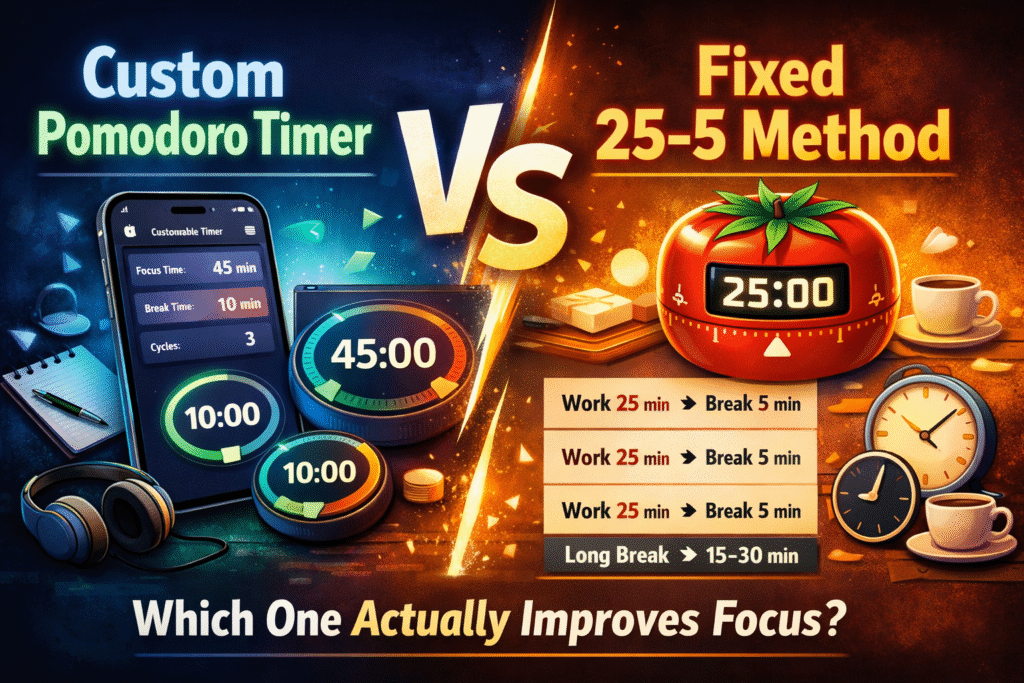

Custom Pomodoro vs Fixed 25-5 Method: Which One Actually Works Better?
Productivity advice often sounds simple: work for 25 minutes, take a 5-minute break, repeat.
That’s the classic Pomodoro technique—and for many people, it genuinely helps.
But here’s the uncomfortable truth most blogs avoid:
👉 If the fixed 25-5 method worked perfectly for everyone, you wouldn’t be searching for alternatives.
In this article, we’ll break down Custom Pomodoro vs Fixed 25-5 Method with real-world context, psychology, and practical use cases—so you can choose (or design) a custom pomodoro timer that actually fits your brain, energy, and work style.
Introduction: Why the “One-Size-Fits-All” Pomodoro Feels Limiting
The original Pomodoro method was created by Francesco Cirillo in the late 1980s. It was brilliant for its time: simple, structured, and revolutionary for focus.
But work has changed.
- Students study for variable cognitive loads
- Developers enter deep flow
- Creators switch between thinking, writing, and editing
- Founders juggle context switching all day
Yet the 25-5 rule stays fixed.
That’s where the idea of a custom pomodoro timer comes in—not as a replacement, but as an evolution.
What Is the Fixed 25-5 Pomodoro Method?
The fixed Pomodoro method follows this exact cycle:
- 25 minutes of focused work
- 5 minutes of break
- After 4 cycles → 15–30 minute long break
Why It Became Popular
- Easy to remember
- Reduces procrastination
- Creates urgency without overwhelm
- Works well for beginners
Where It Starts Breaking Down
- 25 minutes may feel too long for low-energy days
- Or too short for deep focus tasks
- The same break length doesn’t suit all tasks
What Is a Custom Pomodoro Timer?
A custom pomodoro timer allows you to control:
- Focus duration (10, 15, 30, 45, 60+ minutes)
- Break duration (2–15 minutes)
- Number of cycles before long breaks
- Task-specific timers
- Energy-based adjustments
Instead of forcing your brain to follow a rule, the rule adapts to your brain.
Fixed 25-5 vs Custom Pomodoro: Side-by-Side Comparison
| Aspect | Fixed 25-5 Method | Custom Pomodoro Timer |
|---|---|---|
| Flexibility | ❌ None | ✅ Fully adjustable |
| Beginner-friendly | ✅ Very easy | ⚠️ Needs setup |
| Deep work support | ❌ Limited | ✅ Excellent |
| Low-energy days | ❌ Often exhausting | ✅ Can shorten sessions |
| Task variation | ❌ Same for all tasks | ✅ Task-specific |
| Long-term sustainability | ⚠️ Medium | ✅ High |
Why 25 Minutes Feels “Too Long” for Many People
This is one of the most searched frustrations around Pomodoro.
Common reasons:
- Mental fatigue
- Anxiety before starting
- Task ambiguity
- Low motivation days
- Cognitive overload
Forcing 25 minutes in these states doesn’t build discipline—it builds resistance.
👉 A custom pomodoro timer lets you start with 10–15 minutes, reduce friction, and build momentum naturally.
Why 25 Minutes Feels “Too Short” for Deep Focus
On the flip side, some users report:
“Just when I get into flow, the timer interrupts me.”
This happens when:
- Writing long-form content
- Coding
- Solving complex problems
- Studying conceptual subjects
In these cases, 45–60 minute custom focus blocks outperform the classic method—with longer recovery breaks.
The Psychology Behind Custom Pomodoro
The fixed method relies on external discipline.
Customization supports internal awareness.
What a custom pomodoro timer teaches you:
- Your real attention span
- Your best focus hours
- Which tasks drain energy faster
- When breaks actually help
This turns Pomodoro from a timer into a self-diagnostic tool.
When Fixed 25-5 Works Best (Yes, It Still Has a Place)
To be fair, the classic method shines when:
- You’re a complete beginner
- You’re restarting after burnout
- Tasks are simple and repetitive
- You need structure more than insight
If you’ve never used Pomodoro before, start with 25-5.
But don’t stay there forever.
When a Custom Pomodoro Timer Clearly Wins
Choose a custom pomodoro timer if:
- Your energy fluctuates daily
- You do mixed cognitive tasks
- You feel stressed by rigid timers
- You want data, not guilt
- You value long-term consistency
Many modern focus tools (including web-based Pomodoro apps) now quietly encourage customization because retention improves when users feel in control.
Real-World Custom Pomodoro Examples
🧠 Low-Energy Day
- Focus: 15 min
- Break: 5 min
- Goal: Start without resistance
🔥 Deep Work Session
- Focus: 50 min
- Break: 10 min
- Goal: Maintain flow
📚 Study Revision
- Focus: 30 min
- Break: 7 min
- Goal: Balance recall + rest
No single pattern wins. Adaptation does.
The Hidden Benefit: Custom Pomodoro Reduces Self-Blame
One of the biggest productivity problems today isn’t laziness—it’s self-judgment.
When people fail at 25-5, they assume:
“I’m bad at focusing.”
A custom pomodoro timer reframes the problem:
“This duration doesn’t fit me—yet.”
That mindset shift alone improves consistency.
How to Transition from Fixed to Custom (Without Overthinking)
- Start with 25-5 for 3–5 days
- Notice when focus breaks naturally
- Adjust only one variable at a time
- Duration OR break length
- Track what feels sustainable
- Lock in your baseline rhythm
Avoid chasing perfection. The goal is repeatability, not optimization obsession.
Final Verdict: Custom Pomodoro vs Fixed 25-5
Let’s be clear:
- Fixed 25-5 is a great starting rule
- Custom Pomodoro is a better long-term system
If productivity is a habit—not a challenge—you need a system that grows with you.
And that’s exactly what a custom pomodoro timer is designed to do.
If the fixed 25-minute rule never felt quite right for you, that’s not a discipline problem—it’s a fit problem.
This is exactly why I built rbpomodoro — a Pomodoro app designed around custom focus cycles, not rigid rules.
You can adjust focus and break lengths based on your energy, task type, and real attention span, instead of forcing yourself into 25–5 every time.
If you want a Pomodoro timer that adapts to you (and not the other way around), try experimenting with a custom pomodoro timer inside rbpomodoro.com and see how your focus actually responds.
Sometimes, productivity improves not by pushing harder—but by listening better.