
Introduction: “Why Does a Productivity Tool Make Me Anxious?”
The Pomodoro Technique is often promoted as a simple, powerful productivity hack. Set a timer for 25 minutes. Work. Take a break. Repeat.
But if you’re here, chances are your experience has been very different.
Instead of feeling focused, you feel pressured.
Instead of clarity, you feel anxious.
Instead of motivation, the ticking timer makes your chest tight.
If you’ve ever thought “Why is pomodoro stressful for me when it works for everyone else?”—you’re not broken. And you’re definitely not alone.
This article breaks down why Pomodoro feels stressful for some users, the psychology behind that stress, and how to adapt the method so it works with your brain instead of against it.
What Pomodoro Was Meant to Be (And How It Became Rigid)
The Pomodoro Technique was created by Francesco Cirillo as a gentle structure, not a strict rulebook.
The original idea was simple:
- Reduce overwhelm
- Improve focus in short bursts
- Make work feel lighter, not heavier
But over time, Pomodoro turned into a fixed productivity standard:
- 25 minutes only
- You must finish the session
- Breaking focus = failure
That shift is exactly where stress begins.
Why Pomodoro Feels Stressful for Some Users
1. The Timer Creates Performance Pressure
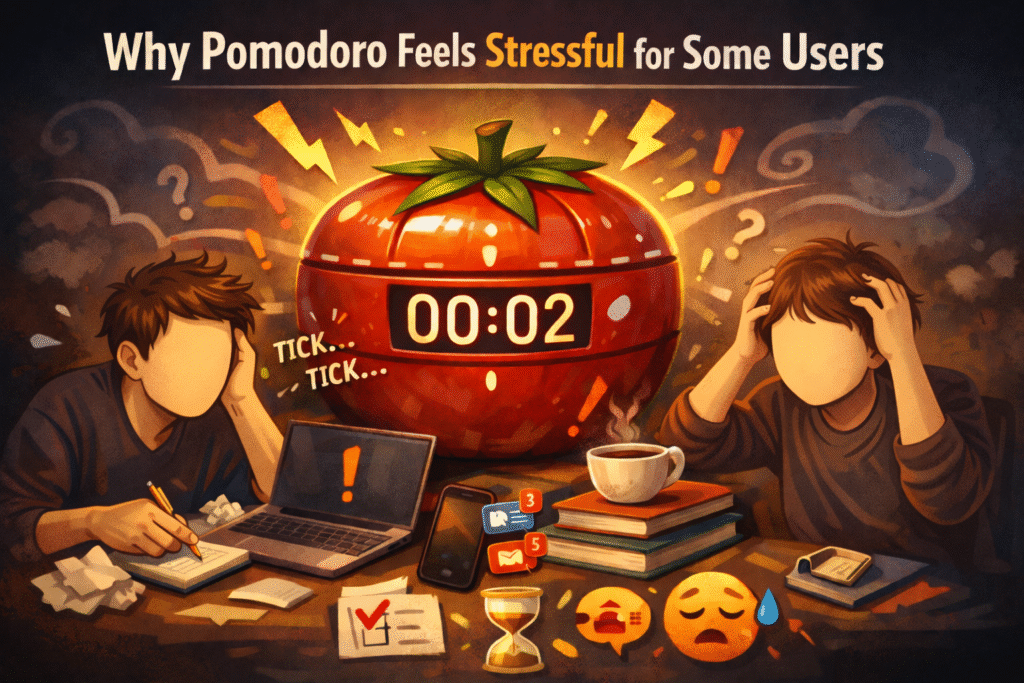
For many people, a ticking clock doesn’t motivate—it threatens.
Instead of thinking:
“I have time to focus”
Your brain hears:
“I must perform perfectly for the next 25 minutes”
This turns Pomodoro into a mini exam, not a support tool.
Common thoughts during stressful Pomodoros:
- “What if I lose focus?”
- “I’m already wasting time”
- “I can’t stop now, the timer is running”
That mental pressure alone is enough to reduce focus.
2. Fixed Time Blocks Ignore Natural Energy Cycles
Not all brains work in clean 25-minute chunks.
Some people:
- Focus deeply for 10–15 minutes
- Need longer warm-up time
- Work best in irregular bursts
When your natural rhythm doesn’t match the timer, Pomodoro feels like forcing your brain into the wrong gear.
| Natural Focus Style | 25-Min Pomodoro Effect |
|---|---|
| Slow starter | Stress before momentum |
| Short focus bursts | Fatigue halfway |
| Deep immersion | Anxiety near timer end |
Instead of supporting focus, the method interrupts it.
3. Fear of “Failing” the Session
Many users subconsciously treat Pomodoro as a pass/fail system.
If you:
- Check your phone
- Zone out for 30 seconds
- Feel tired
You assume the session is ruined.
This creates self-judgment, not productivity.
And the brain learns:
“Pomodoro = pressure + guilt”
No wonder it feels stressful.
4. Breaks Don’t Feel Safe or Refreshing
Ironically, breaks are supposed to reduce stress.
But for many users:
- 5 minutes feels too short
- You spend the break worrying about the next session
- You don’t actually mentally rest
So instead of:
Work → Recover → Reset
It becomes:
Work → Rush → Anxiety → Repeat
That constant cycle builds tension fast.
5. Pomodoro Highlights Mental Fatigue (Instead of Fixing It)
Pomodoro doesn’t create energy—it reveals how much you have.
If you’re:
- Sleep deprived
- Emotionally overwhelmed
- Mentally overloaded
The timer magnifies that exhaustion.
You’re not bad at Pomodoro. You’re just tired.
The Hidden Psychology: Why Structure Can Backfire
Structure helps when it feels optional.
But when structure feels:
- Mandatory
- Monitored
- Non-negotiable
The brain reacts with resistance.
This is called psychological reactance—the natural pushback against perceived control.
For some users, Pomodoro triggers that exact response:
“I don’t want to be told when to focus.”
That internal rebellion shows up as stress, distraction, or avoidance.
Signs Pomodoro Is Stressing You (Not Helping)
You might be forcing the method if:
- You feel relief when the timer ends—not accomplishment
- You delay starting because you “don’t feel ready”
- You restart sessions multiple times
- You associate productivity with tension
These are signals—not failures.
How to Fix Pomodoro Stress (Without Quitting Productivity)
1. Make the Timer Flexible, Not Fixed
Replace 25 minutes with:
- Energy-based sessions (12, 18, 30 min)
- “Focus until distraction” blocks
- Short sprints + long rest
The goal is clarity, not compliance.
2. Redefine Success Inside a Session
Success is not: ❌ Perfect focus
❌ No distraction
Success is: ✅ Returning attention
✅ Staying present
✅ Not quitting
When the definition changes, stress drops instantly.
3. Use Timers as Boundaries, Not Bosses
Think of the timer as:
“I can stop after this”
Not: “I must continue until this ends”
That mental shift removes pressure.
4. Schedule Pomodoro Only During High-Energy Hours
Instead of forcing sessions all day:
- Identify your naturally focused hours
- Use structured focus only there
- Do lighter tasks elsewhere
Productivity improves when timing respects biology.
5. Try “Soft Pomodoro” Variations
If classic Pomodoro feels stressful, experiment with:
- 15 min focus / 10 min rest
- Count-up timers (no ticking pressure)
- Task-based focus (finish a unit, then stop)
There is no single correct format.
Pomodoro Isn’t the Problem—Rigid Productivity Is
The biggest misconception is thinking:
“If Pomodoro stresses me, I lack discipline.”
In reality:
- Stress means the system doesn’t fit you
- Productivity should reduce mental load
- Tools must adapt to humans—not the other way around
Pomodoro is a framework, not a rule.
Conclusion: Stress Is Feedback, Not Failure
If pomodoro feels stressful, your brain is giving you data—not excuses.
Listen to it.
Adjust the structure. Change the duration. Redefine success.
Productivity should feel supportive, not suffocating.
Call to Action (CTA)
If you’ve experienced Pomodoro stress:
- Share what part feels most difficult for you
- Experiment with one flexible change this week
- Explore focus tools that adapt to your energy instead of forcing time blocks
👉 Productivity works best when it respects your mind.
If you want more insights on focus, mental energy, and realistic productivity systems, explore related articles on adaptive focus techniques and energy-based planning.