
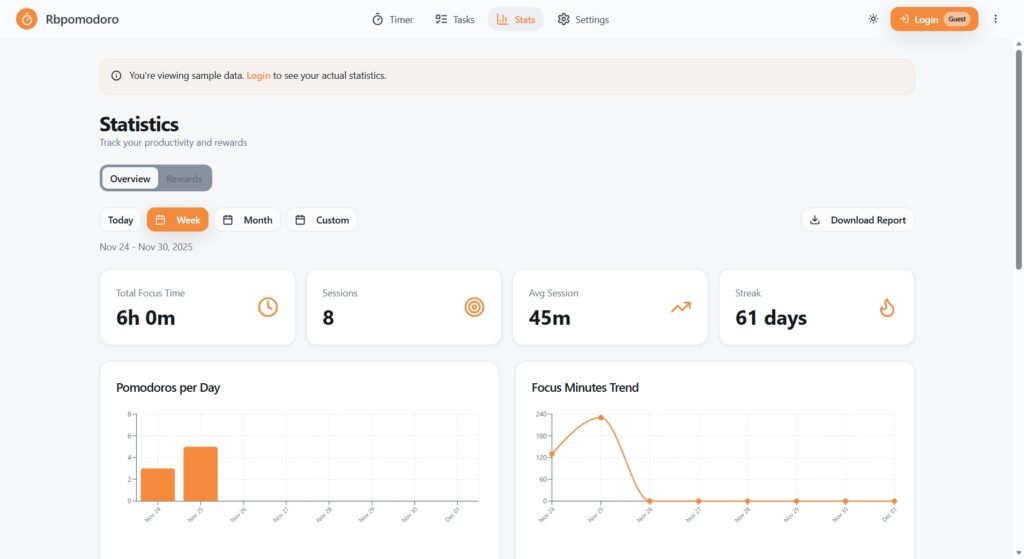

You finish a Pomodoro session.
Then another.
Then a few more across the week.
But when you open your dashboard and look at your pomodoro session history, a question quietly appears:
“What am I actually supposed to learn from this?”
Most people treat session history like a receipt — time in, time out, done.
That’s a huge missed opportunity.
Your Pomodoro history is not just data.
It’s behavioral proof of how you really work, not how you think you work.
In this guide, I’ll show you how to read Pomodoro session history using real examples, what patterns matter, what numbers to ignore, and how to turn history into better focus decisions.
🧠 AI can’t show your dashboard
🎯 Visual proof → click (your own app history matters more than generic advice)
Why Pomodoro Session History Matters More Than the Timer
Most productivity advice stops at:
- “Work 25 minutes”
- “Take a break”
- “Repeat”
But Pomodoro works only when reflection follows execution.
Your pomodoro session history answers questions like:
- When do I actually focus best?
- Do I fail sessions because of time length, task difficulty, or energy?
- Am I improving… or just repeating effort?
Without history, Pomodoro is just a stopwatch.
With history, it becomes a mirror.
What Counts as Pomodoro Session History?
Before we analyze, let’s clarify what session history usually includes:
| Data Point | What It Represents |
|---|---|
| Session start & end | When you worked |
| Duration | 25, 30, or custom |
| Completion status | Finished / abandoned |
| Break behavior | Took break or skipped |
| Time of day | Energy alignment |
| Streaks | Consistency over time |
Not every app shows all of this — but even partial history is powerful if read correctly.
Example 1: The “Looks Consistent but Isn’t” Trap
Let’s say your pomodoro session history shows:
- 4–5 sessions every day
- Similar durations
- No obvious gaps
At first glance: Looks productive.
Now zoom deeper 👇
What to Check
- Are sessions completed or abandoned?
- Do failures cluster at a certain time?
- Do sessions shorten as the day progresses?
Real Insight
Many users discover:
- Morning sessions = clean completions
- Evening sessions = frequent early exits
Conclusion:
The problem isn’t discipline.
It’s energy misalignment.
👉 Action: Schedule harder tasks only during your historically strong hours.
Example 2: High Session Count, Low Output
Another common pomodoro session history pattern:
- 8–10 sessions per day
- Short breaks
- Very few long streaks
Sounds intense.
But intensity ≠ effectiveness.
Hidden Meaning
This often signals:
- Task switching
- Anxiety-driven restarting
- “Busy focus” instead of deep focus
What History Is Telling You
Your brain is resetting too often.
👉 Action:
- Reduce daily session target
- Increase session quality
- Add one anchor task per day
How to Read Time-of-Day Patterns (This Is Gold)
One of the most underrated insights inside pomodoro session history is time-based performance.
Ask yourself:
- At what hour do sessions complete most often?
- When do abandonments spike?
- When do breaks turn into scroll sessions?
Common Pattern Found in Real Users
| Time | Session Quality |
|---|---|
| 6–9 AM | High completion |
| 12–2 PM | Mental resistance |
| 4–6 PM | Short attention |
| Late night | False productivity |
Important:
Late-night sessions feel productive but often show:
- More retries
- Lower completion confidence
- No carryover momentum next day
👉 Action: Trust your history, not your mood.
Example 3: Failed Pomodoros Are Not Failure
Most people see failed sessions and think:
“I’m bad at focusing.”
Wrong.
Failed sessions are diagnostics, not verdicts.
Read Failed Sessions Like This
- When did they fail?
- How long before stopping?
- What task type was it?
Real Insight
If failures consistently happen:
- At minute 8–12 → session too long
- On specific subjects → cognitive load issue
- After multiple successes → fatigue, not laziness
👉 Action:
- Shorten sessions for heavy tasks
- Insert recovery breaks, not scroll breaks
The Pattern Most People Miss: Session Clustering
Open your pomodoro session history and look for clusters:
- Back-to-back successes
- Back-to-back failures
Why This Matters
Focus is state-based, not session-based.
If you see:
- 3 clean sessions in a row → ride the wave
- 2 failed sessions in a row → stop forcing
👉 Action:
- Work with momentum
- Stop sessions early when resistance appears repeatedly
What Numbers You Should Ignore
Not everything in pomodoro session history deserves attention.
❌ Total sessions per day
❌ Longest streak ever
❌ Comparing with others
These inflate ego or guilt — not insight.
What to Track Instead
✅ Completion rate by hour
✅ Average successful session length
✅ Recovery time after failure
These answer why, not just how much.
Turning Pomodoro Session History into Daily Decisions
Here’s a simple daily reflection flow:
- Open yesterday’s session history
- Answer three questions:
- When did focus feel easiest?
- When did it resist?
- What task worked best?
- Plan today around those answers
This takes 2 minutes
and saves hours of forced focus
Why AI Can’t Replace This Insight
AI can give advice.
Blogs can give frameworks.
But AI can’t see your exact pomodoro session history.
Only your dashboard shows:
- Your real energy
- Your real limits
- Your real progress
That’s why visual proof beats theory.
🎯 Visual proof → click
(Your session history already contains the answers.)
Stop guessing why focus breaks — see the pattern instead.
Track, read, and improve your pomodoro session history with real insights at Rbpomodoro.com.
Select 77 more words to run Humanizer.
Final Thought: Your History Is Already Coaching You
You don’t need a new technique.
You don’t need longer sessions.
You don’t need more discipline.
You need to read what your pomodoro session history is quietly telling you.
Once you do, Pomodoro stops being stressful…
and starts becoming personal.