
There are days when productivity advice feels almost insulting.
You sit at your desk.
Your to-do list is clear.
But your body feels heavy, your mind foggy, and even starting feels exhausting.
On days like these, the classic Pomodoro method—25 minutes of focused work followed by a 5-minute break—can feel overwhelming rather than helpful.
If you’ve ever thought “Pomodoro works… just not when I’m this tired”, this post is for you.
Let’s talk honestly about how to use Pomodoro on low-energy and burnout days, without guilt, pressure, or pretending you’re at 100%.
Understanding Low-Energy vs Burnout (They’re Not the Same)
Before fixing productivity, it helps to name the problem.
Low-Energy Days
These are temporary.
- Poor sleep
- Mental overload
- Emotional stress
- Physical tiredness
You can work—but only gently.
Burnout Days
These are deeper.
- Emotional numbness
- Loss of motivation
- Everything feels “too much”
- Even small tasks cause resistance
On burnout days, productivity systems must reduce pressure, not increase it.
Traditional Pomodoro often fails here because it assumes:
- Stable energy
- High mental clarity
- Willpower to “push through”
That assumption is wrong for many people.
Why Standard Pomodoro Feels Too Hard on Low-Energy Days
Let’s be honest about the friction.
1. 25 Minutes Feels Like a Commitment
When energy is low, your brain doesn’t hear “25 minutes”.
It hears “a long stretch of suffering.”
2. The Timer Creates Pressure
Instead of helping focus, the ticking clock feels like judgment:
“You should be doing more.”
3. Guilt After Incomplete Sessions
Stopping early can make you feel like you “failed” the system.
That’s not a motivation problem.
That’s a system mismatch.
Reframing Pomodoro for Low-Energy & Burnout Days
The goal on these days is not productivity.
The goal is:
- Showing up
- Reducing mental resistance
- Creating safety around starting
On low-energy days, Pomodoro should answer one question:
“What is the smallest unit of effort I can complete without stress?”
The Low-Energy Pomodoro Rule (Very Important)
Here’s the mindset shift that changes everything:
A Pomodoro is not a performance test.
It’s a container for gentle effort.
Once you accept this, you can reshape the technique.
5 Pomodoro Adjustments That Actually Work on Low-Energy Days
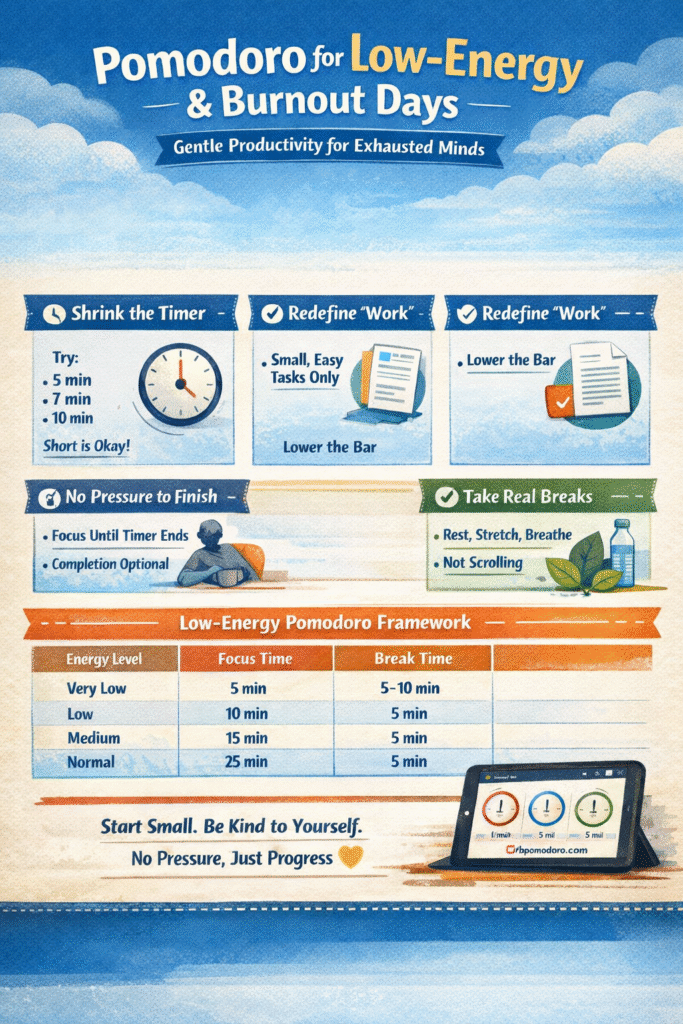
1. Shrink the Timer (Radically)
Forget 25 minutes.
Try:
- 5 minutes
- 7 minutes
- 10 minutes
Yes, even 5 minutes counts.
The magic isn’t duration—it’s starting without fear.
Once you start, energy often follows a little.
If it doesn’t, that’s okay too.
2. Redefine “Work” for the Session
On burnout days, “work” can mean:
- Opening the document
- Reading one page
- Organizing files
- Writing bullet points (not full paragraphs)
You’re lowering the activation energy, not lowering your standards forever.
3. Remove the Pressure to Complete the Task
Low-energy Pomodoro has only one rule:
Stay with the task until the timer ends—
not until the task is finished.
Completion is optional.
Presence is enough.
4. Take Real Rest Between Sessions
Scrolling is not rest when you’re burned out.
Better break ideas:
- Closing your eyes
- Stretching
- Walking slowly
- Drinking water
Rest should restore, not stimulate.
5. Stop Early Without Guilt
If your body says “enough”:
- Stop
- Acknowledge effort
- Walk away kindly
Stopping early is not failure.
It’s self-regulation.
Pomodoro for Burnout Days: A Different Goal Altogether
On true burnout days, productivity is not the priority.
Your Pomodoro goal becomes:
- Rebuilding trust with yourself
- Making work feel safe again
- Avoiding emotional exhaustion
This is where gentle timers matter.
Instead of asking:
“How much did I get done?”
Ask:
“Did I show up without harming myself?”
A Simple Low-Energy Pomodoro Framework
Here’s a realistic structure you can try:
| Energy Level | Focus Time | Break Time | Goal |
|---|---|---|---|
| Very Low | 5 min | 5–10 min | Just start |
| Low | 10 min | 5 min | Stay present |
| Medium | 15 min | 5 min | Light progress |
| Normal | 25 min | 5 min | Deep work |
Notice something important:
Energy decides the timer—not discipline.
Why Custom Pomodoro Works Better Than Fixed Pomodoro
Fixed systems assume consistency.
Humans are not consistent.
Your energy:
- Changes daily
- Changes hourly
- Changes emotionally
That’s why many people quit Pomodoro—not because they’re lazy, but because the system refuses to adapt.
This is exactly the gap I noticed while struggling with low-energy days myself.
I didn’t need motivation.
I needed permission to work gently.
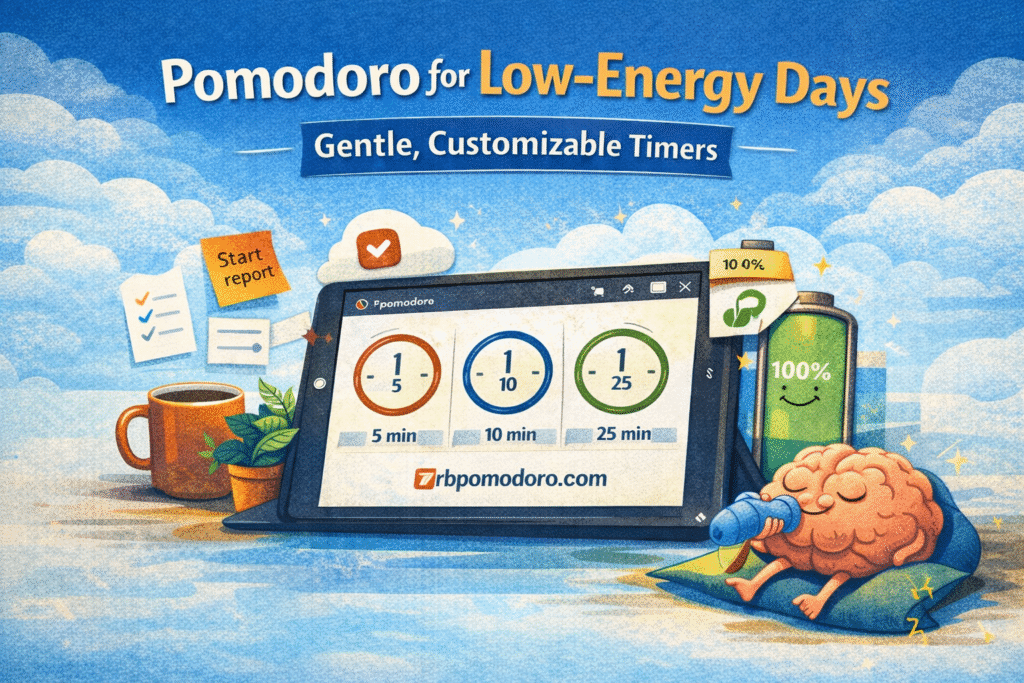
That’s why tools like rbpomodoro.com focus on custom session lengths instead of forcing 25 minutes.
You can:
- Set very short focus sessions
- Adjust based on how you feel right now
- Track effort without guilt or pressure
It’s not about pushing harder—it’s about staying consistent without burning out.
What Progress Looks Like on Low-Energy Days (Important)
Let’s redefine progress.
Progress is:
- One honest session
- One gentle start
- One moment of focus
Progress is not:
- Long hours
- Perfect streaks
- High-output days
Low-energy days are part of a long journey—not a deviation from it.
Common Mistakes to Avoid
❌ Forcing Yourself Into 25 Minutes
This creates resistance and avoidance.
❌ Comparing Output to High-Energy Days
Different energy, different expectations.
❌ Using Pomodoro as Self-Punishment
Timers should support you—not shame you.
A Gentle Mindset Shift That Changes Everything
Instead of saying:
“I need to be productive today.”
Try:
“I will do what my energy allows, without judgment.”
Pomodoro works best when it feels like support, not pressure.
Final Thoughts: Pomodoro Is a Tool, Not a Rule
On low-energy and burnout days:
- Smaller sessions are smarter
- Gentler effort is sustainable
- Consistency beats intensity
If Pomodoro has ever felt stressful to you, it doesn’t mean the method failed.
It means the version you used wasn’t designed for real human energy levels.
Start smaller.
Be kinder.
Adapt the system to you.
And if you want a Pomodoro experience built specifically for low-energy days—where you control the session length, pace, and pressure—you can explore rbpomodoro.com as a calm place to begin again.
👉Action
If you’re tired of quitting productivity systems on burnout days, try a custom, low-pressure Pomodoro session today.
Start with 5 minutes.
No guilt. No forcing.
Just honest effort—your way.