
Introduction: Why Short Pomodoro Sessions Are Gaining Attention
Most people discover the Pomodoro technique through the classic 25-minute work + 5-minute break rule. It sounds simple. But if you’ve ever sat in front of your screen feeling mentally tired, distracted, or overwhelmed, you already know the problem:
👉 25 minutes can feel too long.
This is where short pomodoro sessions come in.
Short pomodoro sessions (10–20 minutes) are not a shortcut or a “lazy” version of productivity. They are a real, research-backed adaptation designed for modern attention spans, burnout recovery, and low-energy days.
In this guide, we’ll break down:
- What short pomodoro sessions really are
- When they work better than 25-minute sessions
- How to structure them correctly
- Common mistakes to avoid
- How tools like rbpomodoro.com make short sessions actually usable in real life
Let’s dive in.
What Are Short Pomodoro Sessions?
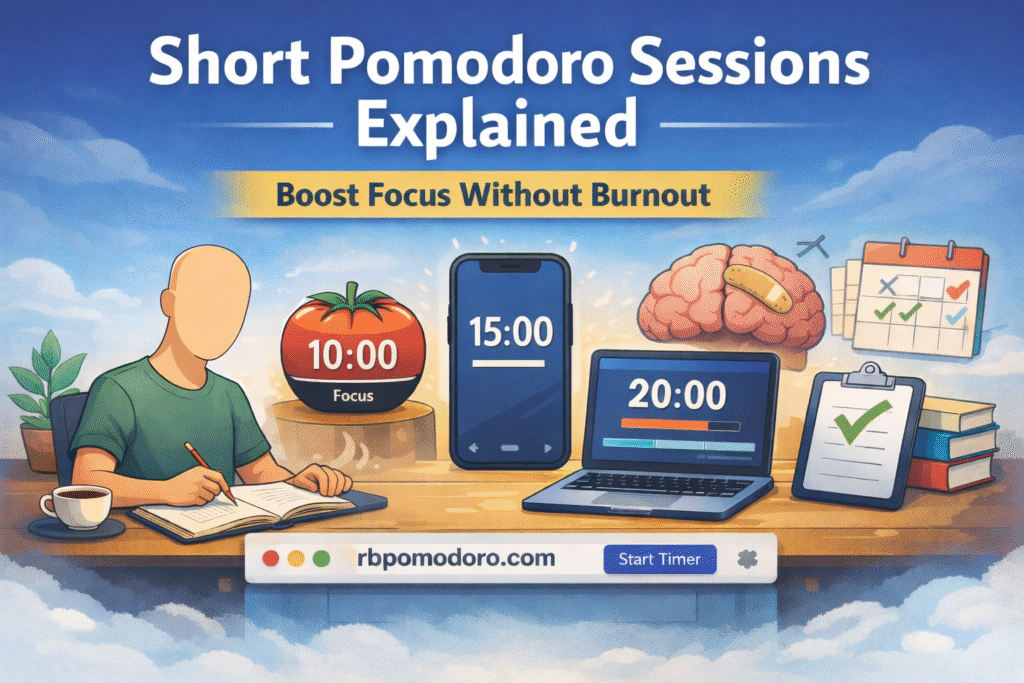
Short pomodoro sessions typically range between 10, 15, or 20 minutes of focused work, followed by a short break.
Instead of forcing yourself to maintain attention for 25 minutes, you:
- Lower the mental entry barrier
- Reduce resistance to starting
- Preserve energy for longer periods
Think of short sessions as “focus sprints”, not endurance runs.
Common Short Pomodoro Formats
| Work Time | Break | Best For |
|---|---|---|
| 10 min | 2–3 min | Extreme fatigue, anxiety, ADHD |
| 15 min | 3–5 min | Low energy, study sessions |
| 20 min | 5 min | Writing, reading, light tasks |
Why 25 Minutes Doesn’t Work for Everyone
The original Pomodoro method was designed decades ago—before:
- Constant notifications
- Multitasking culture
- Digital burnout
- Information overload
The Hidden Problem
When your brain believes a task will take too long, it creates resistance. This leads to:
- Procrastination
- Tab switching
- Fake productivity
Short pomodoro sessions solve this by reducing psychological friction.
“I can focus for 10 minutes” feels achievable.
“I must focus for 25 minutes” feels threatening.
The Science Behind Short Focus Bursts
Research in cognitive psychology shows that:
- Attention fluctuates in short cycles
- Mental fatigue accumulates faster under pressure
- Starting is often harder than continuing
Short sessions work because they:
- Lower dopamine resistance
- Reduce decision fatigue
- Create quick wins that motivate continuation
Once you complete one short session, momentum kicks in naturally.
When Short Pomodoro Sessions Work Best
Short pomodoro sessions are not meant to replace longer sessions forever. They shine in specific situations.
1. Low-Energy Days
On days when:
- Sleep was poor
- Motivation is low
- Your brain feels “foggy”
Short sessions keep you moving without draining you further.
2. Studying Difficult or Boring Topics
Heavy subjects (law, theory, revision) benefit from:
- Shorter focus windows
- Frequent mental resets
This is especially useful for students preparing for competitive exams.
3. Burnout Recovery
If productivity systems make you anxious, short pomodoro sessions:
- Remove pressure
- Rebuild trust with your focus
- Make work feel safe again
Short vs Long Pomodoro Sessions (Quick Comparison)
| Factor | Short Pomodoro Sessions | Traditional 25-Min |
|---|---|---|
| Entry resistance | Very low | Medium to high |
| Best for | Low energy, burnout | High energy, deep work |
| Consistency | Easier daily | Harder on bad days |
| Mental strain | Low | Moderate |
| Momentum | Builds slowly | Builds strongly |
👉 The best system uses both, depending on energy.
The Biggest Mistake People Make With Short Pomodoros
The most common mistake is this:
❌ Treating short sessions as “not real work”
If you:
- Check messages
- Multitask
- Mentally relax
…then even 10 minutes won’t help.
The Rule That Makes Short Sessions Powerful
Short time ≠ low intensity
During those 10–15 minutes:
- One task only
- No switching
- No scrolling
Short pomodoro sessions demand clean focus, not casual effort.
How to Structure Short Pomodoro Sessions Properly
Here’s a simple framework that works consistently:
Step 1: Shrink the Task
Instead of:
“Study History”
Use:
“Read 2 pages”
“Underline key terms”
Step 2: Set a Fixed Short Timer
Choose:
- 10 minutes when exhausted
- 15 minutes when okay
- 20 minutes when warmed up
Step 3: Stop When the Timer Ends
This is critical.
Stopping:
- Preserves mental energy
- Prevents burnout
- Makes restarting easier
Over time, short sessions naturally expand.
Why Most Pomodoro Apps Fail at Short Sessions
Many apps:
- Lock users into 25-minute cycles
- Make custom timers complicated
- Judge productivity by total time
This discourages people who:
- Need flexibility
- Work with fluctuating energy
- Want guilt-free focus
Where rbpomodoro.com Fits Naturally
This is exactly where rbpomodoro.com feels different.
Instead of forcing a rigid system, it:
- Lets you choose any session length
- Tracks effort without judgment
- Helps you understand how you work, not how long
On days when 25 minutes feels impossible, starting a 10-minute session inside rbpomodoro.com still counts as progress—and that mindset shift matters.
A Realistic Short Pomodoro Workflow (Example)
Let’s say you’re preparing for exams but feel mentally drained.
Day Plan:
- 10 min → revise formulas
- 3 min break
- 15 min → solve 3 questions
- 5 min break
- 20 min → review mistakes
Total focused time: 45 minutes
Mental stress: low
Consistency: high
This approach beats forcing one painful 25-minute block and quitting entirely.
Can Short Pomodoro Sessions Increase Deep Work?
Surprisingly—yes.
Short sessions:
- Warm up attention
- Reduce avoidance
- Create flow indirectly
Many people report:
“I planned 15 minutes… ended up doing 40.”
Deep work often starts after resistance is removed, not before.
Who Should Use Short Pomodoro Sessions?
Short pomodoro sessions are ideal for:
- Students with long syllabi
- People recovering from burnout
- ADHD or anxiety-prone users
- Anyone rebuilding consistency
They are not about doing less.
They are about doing what’s possible—consistently.
Final Thoughts: Productivity That Respects Energy
Short pomodoro sessions are not a trend.
They’re a response to how modern brains actually work.
If productivity feels heavy, stressful, or impossible:
- Shrink the time
- Protect your focus
- Build momentum slowly
Tools like rbpomodoro.com exist for this exact reason—not to push you harder, but to help you show up honestly, even on difficult days.
Take an Action 🚀
If traditional Pomodoro never worked for you, try a different approach.
👉 Start with short pomodoro sessions today.
👉 Experiment with flexible timers.
👉 Track effort, not perfection.
Explore how gentle focus feels with rbpomodoro.com—and rebuild your productivity without burnout.
💬 Your turn:
Have you tried short pomodoro sessions before?
What duration works best for your energy level?