
Introduction: Focus Isn’t Just About Working Harder
Most people start the Pomodoro technique with one simple goal: stay focused for 25 minutes.
But here’s the uncomfortable truth most productivity blogs don’t talk about:
Starting a Pomodoro is easy. Staying consistent is hard.
That’s where tracking changes everything.
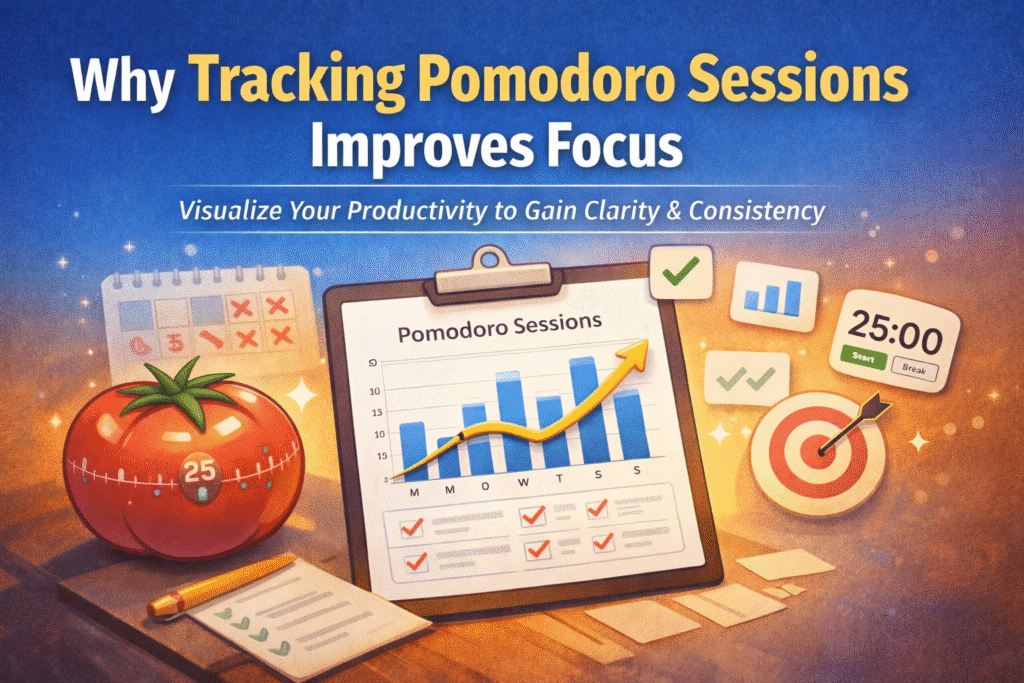
When you track Pomodoro sessions, something subtle but powerful happens. You stop guessing about your focus. You stop lying to yourself about “how productive the day was.” You begin to see patterns—real ones.
In this post, I’ll break down why tracking Pomodoro sessions improves focus, the psychology behind it, common mistakes people make, and how I personally designed tracking into my own Pomodoro workflow while building a simple web app for people who struggle with consistency.
This is not about complex analytics or productivity guilt.
It’s about clarity.
The Real Problem: We Overestimate Our Focus
Humans are terrible at estimating effort.
Ask someone:
- “How long did you actually focus today?”
- “How many deep work sessions did you complete?”
Most answers are guesses.
Psychologists call this recall bias—we remember intentions, not actions.
Without tracking:
- A distracted session feels like work
- A half-finished Pomodoro counts as effort
- A bad day gets emotionally exaggerated
When you track Pomodoro sessions, you replace feelings with facts.
And facts are calming.
What “Tracking Pomodoro Sessions” Really Means
Let’s clear a misconception.
Tracking doesn’t mean:
❌ obsessing over numbers
❌ competing with others
❌ forcing productivity on low-energy days
Tracking does mean:
✅ recording when you started
✅ knowing how many sessions you actually completed
✅ seeing trends over days, not judging single sessions
At its core, tracking answers just one question:
“Did I show up and try?”
That’s it.
How Tracking Pomodoro Sessions Improves Focus (The Psychology)
1. Self-Monitoring Automatically Improves Behavior
In behavioral psychology, there’s a principle called self-monitoring.
The moment behavior is observed, it improves.
Just knowing:
- “This session will be recorded”
- “I’ll see this later”
…makes distractions less tempting.
Not because of discipline—but because awareness increases.
2. Progress Feels Real (Even on Bad Days)
Here’s something counterintuitive:
Tracking helps most on low-productivity days.
Why?
Because:
- 2 completed sessions > “I did nothing”
- Effort becomes visible
- Guilt reduces
When users track Pomodoro sessions, they stop quitting early just because the day “feels unproductive.”
They finish one more session.
That compounds.
3. Focus Turns Into a Measurable Skill
Most people think focus is personality-based:
“I’m just not a focused person.”
Tracking proves otherwise.
When you track Pomodoro sessions over time, you notice:
- Best hours for focus
- Tasks that drain energy faster
- Session lengths that work for you
Focus becomes trainable, not mysterious.
Tracking vs Not Tracking: A Simple Comparison
| Without Tracking | With Tracking |
|---|---|
| Focus feels random | Focus feels structured |
| Bad days feel wasted | Bad days still show effort |
| Motivation depends on mood | Motivation comes from progress |
| Easy to quit early | Easier to continue |
| No learning loop | Clear feedback loop |
Tracking doesn’t make you perfect.
It makes you honest.
Why Most Pomodoro Users Still Don’t Track
From my own experience (and talking to users), most people avoid tracking because:
- Too much data = pressure
- Apps feel complex or judgmental
- Stats feel like school report cards
- Fear of “seeing low numbers”
Ironically, this avoidance keeps people stuck.
The solution isn’t more data.
It’s gentle tracking.
My Personal Shift: From Timer → Tracker
When I first used Pomodoro timers, I failed repeatedly.
Not because the technique didn’t work—but because:
- I couldn’t see progress
- I forgot sessions after closing the tab
- I had no feedback loop
That’s why, while building RbPomodoro, I focused on one principle:
Tracking should feel like reflection, not evaluation.
Instead of overwhelming charts, the app quietly records:
- Completed Pomodoro sessions
- Daily effort history
- Simple visual feedback
No competition.
No streak shame.
Just truth.
And something surprising happened.
Users didn’t ask, “How do I be more productive?”
They asked, “How can I show up more often?”
That’s real progress.
If you want tracking to improve focus (not anxiety), follow these rules:
Rule 1: Track Sessions, Not Hours
Hours create pressure.
Sessions create clarity.
Rule 2: Count Completion, Not Perfection
A messy session still counts if you stayed.
Rule 3: Review Weekly, Not Hourly
Patterns matter more than moments.
Rule 4: Let Data Inform—Not Judge
Data is feedback, not a verdict.
This philosophy is baked into how rbpomodoro.com works.
What Changes After 7–14 Days of Tracking
Most users report these shifts:
- Less guilt on low-energy days
- Better awareness of distractions
- Fewer abandoned sessions
- More realistic planning
- Increased confidence in their effort
Not motivation hype.
Just quiet consistency.
The Long-Term Benefit: Focus Identity
The biggest benefit of tracking Pomodoro sessions isn’t productivity.
It’s identity.
You stop saying:
“I’m bad at focusing.”
And start thinking:
“I usually complete 3–4 sessions when I start.”
That belief alone changes behavior.
Common Mistakes to Avoid When Tracking
❌ Tracking every micro-detail
❌ Comparing numbers with others
❌ Chasing streaks aggressively
❌ Treating data like self-worth
Tracking works best when it’s private, simple, and forgiving.
Final Thoughts: Focus Improves When Awareness Improves
Tracking Pomodoro sessions doesn’t magically give you discipline.
It gives you awareness.
And awareness is the foundation of:
- Better focus
- Better habits
- Better self-trust
If you’ve tried Pomodoro before and quit, don’t blame yourself.
Try again—but this time, track Pomodoro sessions gently.
If you want to experience calm, non-judgmental tracking,
you can try my simple Pomodoro web app here:
No downloads.
No pressure.
Just one task, one timer, and quiet progress you can finally see.
If this post helped you rethink how you track focus, feel free to share it—or explore related posts on Pomodoro fatigue, low-energy days, and custom session lengths.